

Forum Replies Created
-
AuthorPosts
-
Quote:That’s certainly very familiar to Jesus and his entourage; – ‘Drink this, this is my blood, eat this, this is my flesh’, type thing… ritual canabalism then practiced for thousands of years at every Catholic Mass… you dont really need to do a Mass backwards to create a ‘Black Mass’, it’s a pretty macabre thing already! lol
You’re right Yuri, though it had never occured to me. Some opponents of early Christianity made the charge that the christians were cannibals because of this (centuries later we used the same charge against witches and heretics of various stripes). You should see the gospel of John, chapter 6:54-56
Quote:Those who eat my flesh and drink my blood have eternal life, and I will raise them up on the last day; for my flesh is true food and my blood is true drink. Those who eat my flesh and drink my blood abide in me, and I in them.It’s an old idea for sure. In the Egyptian Pyramid Texts there is the so-called ‘Cannibal Hymn’ (I can’t give Utterance references at the moment), in which the king steadily consumes the gods, which probably indicates his attaining to their power or various states of consciousness.
Back to the head of JtheB, I am intrigued by this idea that it might have found its way into the possession of Jesus and his group. I have been thinking about some other of Jesus’ activities. Look at this from Mark 9:2-5
Quote:Six days later, Jesus took with him Peter and James and John, and led them up a high mountain apart, by themselves. And he was transfigured before them, and his clothes became dazzling white, such as no one on earth could bleach them. And there appeared to them Elijah with Moses, who were talking with Jesus.Jesus was apparently interested in contacting with the dead, in this case Moses and Elijah (we christians have been a bit hard on mediums, considering that Jesus appears here to be a powerful physical medium). Later on, as they were coming down the mountain, there is an interesting exchange about Elijah in verses 11-13.
Quote:Then they asked him, “Why do the scribes say that Elijah must come first?” He said to them, “Elijah is indeed coming first to restore all things. How then is it written about the Son of Man, that he is to go through many sufferings and be treated with contempt? But I tell you that Elijah has come, and they did to him whatever they pleased, as it is written about him.”Jesus evidently thought that JtheB was Elijah. Perhaps he did possess the head in order to ‘maintain contact’? OK, it’s a bit wild.
Michael
Hello Mad Dan,
Thanks for your input.
Quote:I would imagine that African throwing-knives are made this way coincidentally, because there aren’t that many conveniently throwable simple shapes – otherwise you’d end up having to consider the mystical imagery concealed in quite a few of the wares at your local boomerang shop (if you have one – I do, which is nice, though very seldom useful).I appreciate your point. On the other hand, you could say the same about swords and daggers, which are conveniently shaped for sticking into people, but also have a wealth of symbolic associations. I have no idea if I have a local boomerang shop, it never occured to me to look.
As far as solar/masculine symbolism goes I didn’t realise that the number three had those associations. I’m not denying that it may do, but it also has lunar/feminine associations. In the case of the three-armed Brigid cross I suppose you have a potential solar/feminine association. Pesky symbols; you think you understand them, and then you come across something else which gives them the opposite meaning!
I came upon the Glastonbury Tor labrynth, and I also came across claims that it is contrived or perhaps modern. Of course, I don’t see a reason why we can’t continue to create valid symbols in the landscape; there is a bias towards the ancient. Nevertheless, I’ve got a copy of Herodotus, I’ll see if I can find that reference (might take some time). Anyone else have any idea about the antiquity or otherwise, or the existence or otherwise, of the Glastonbury labrynth?
My attention was originally drawn to the Rocky Valley labrynths near Tintagel, and it is worth noting that there have also been doubts expressed about their antiquity (though they definitely exist). I visited them and I can’t say anything much seemed to result at the time, though circumstances weren’t ideal. Mind you, a while earlier in the comfort of my own home I did do a labrynth meditation and half-fried my brains
 – Vyxen gave me some advise that arrived a day too late!
Cheers,
Michael
I thought you would know better by now Yuri; following a similar call last year you have been afflicted with over 60 frequently rambling, sometimes pompous and occasionally barmy posts from me.
But seriously (honestly), I second Yuri. Involvement in the forums with a suitably open mind has the potential to stir things up.
Quote:All you have to do is start talking, focus on a theme, and magic will start happening, synchronicities in your life will occur, that’ll lead you on to new discoveries… and bigger synchronicities…I’ve found that to be true for myself. It really is the case that you get out what you put in.
Michael
Andrew Collins has posted a piece on his website about this affair:
[url:24718y9d]http://www.andrewcollins.com/[/url]
It has an upbeat, optimistic tone, and some interesting thoughts on the significance of the Green Stone.
Regards to you all,
Michael
I dug out my guide book from when we spent a hot afternoon in Ephesus a few years ago. It’s a huge ruin, and we didn’t see it all, in particular we didn’t see most of the places I’m about to mention. There are some interesting things about Ephesus.
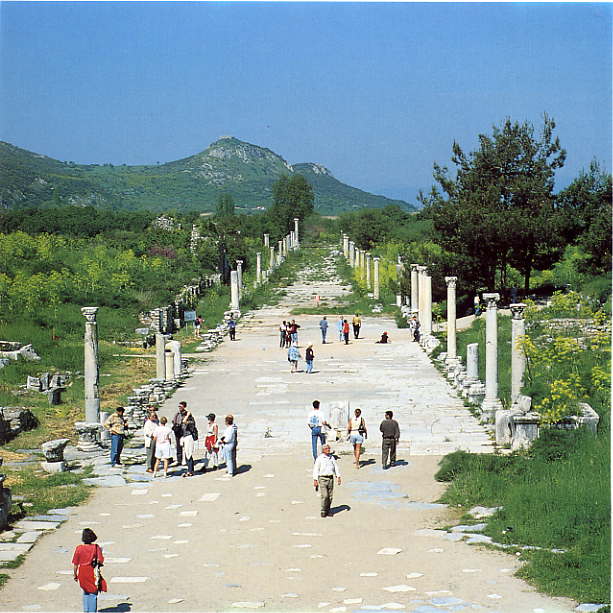
A general of Alexander the Great, Lysimachos, is credited with moving the city to a more uphill position, and it would be this later city that John/Lazarus/Whoever would have known. If the ‘straight street’ is often the road leading from the port as conjectured by your archaeologist, then in Ephesus the obvious candidate is what is sometimes called Harbour Street; this was named Arcadian street by Emperor Arcadius (395-408), who had it renovated and rebuilt. It is very straight, about 500 or 600 meters long and 11m wide, leading from the old harbour to the Great Theatre. There were covered porticos on both sides of the street which hosted shops. In the 6th century the Emperor Justinian erected four columns alongside the road that are known as the Four Evangelists, and which once had statues of said evangelists on them. Here is a pic of the road:
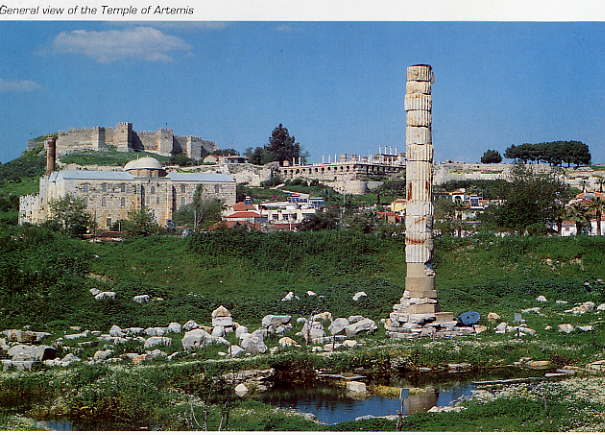
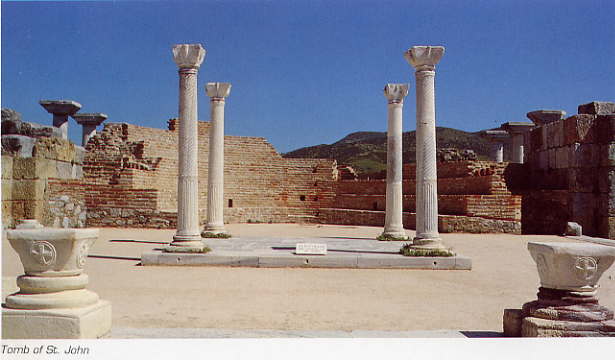
Tradition from several 2nd century sources (according to the Catholic Encyclopedia) state that John died in Ephesus, and his tomb is supposedly located on Ayosolug Hill. A small basilica was built over it in the 4th century, and Justinian replaced this with a larger basilica in the 6th century. My guide book appears not to have been translated too well, but it alludes to a holy well nearby, around or in which coins have been found dated to the second half of the first century. The Church of St John was within a stone’s throw of the mighty Temple of Artemis. The pic here shows a column of the temple in the foreground; I think that on the higher ground to the left of the column is the church, with a later fortress higher up. The next pic shows the tomb of St John. It has or had five satellite tombs, arranged in a cross shape.
Tradition also had it that John was accompanied to Ephesus by Mary Magdalene and the BVM (Blessed Virgin Mary). Mary Magdalene was supposed to have died there, and in 899 her relics were transferred from Ephesus to Constantinople by Leo the Wise. This is in contradiction, of course, to the French tradition which has Magdalene and Lazarus move to Marseilles.
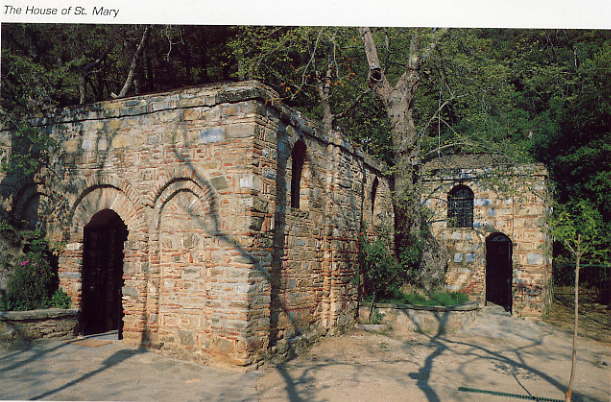
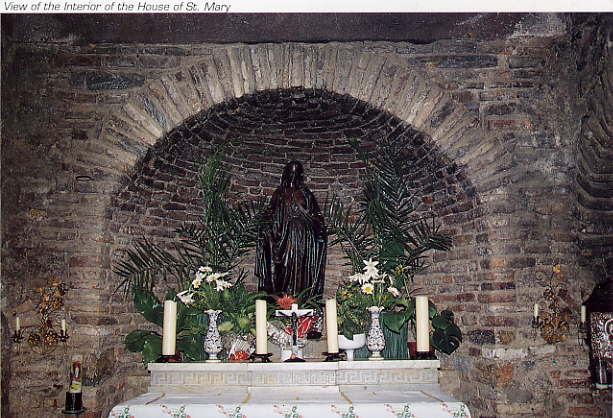
As far as the BVM is concerned, Ephesus claimed to be her first cult-centre, but her tomb was always held to be near Jerusalem. There is an interesting questing story which changed this however. Somewhere between 1822 and 1824 a Bavarian nun called Catherine Emmerich went into trance and saw the location of the house of the BVM. Despite never having left Germany she described the location of the house, stating that it was a little distance from the main city and that from it you could see the Agean Sea and the road leading to the Church of St Mary (situated very close to Harbour Street, which might be our straight street). She seems also to have predicted the finding of ash in a fireplace. In 1892 two priests, Mr Poulain and Mr Young, went to investigate and after a search found the house in the situation as described on Bulbul Dag, complete with ash in the fireplace. Unfortunatley they didn’t find the grave of the BVM, which Catherine Emmerich had said was less than 500m from the house. There is a fountain of Mary there as well, reputed to have healing powers, as is the ash in the fireplace in Mary’s house. Here are some pics of the house, outside and inside:
Michael
Just a few comments on recent posts.
No-one is obliged to donate to the Green Stone fund. If you don’t agree with Andrew Collins and his group gaining posession of the stone then fair enough; you can put in your own bid, form your own consortium, or do nothing. Some of us are backing AC in this, and are urging others to do likewise, but if you don’t want to then fine.
I think the terms of the fund are clear that this isn’t about democracy. If AC and co own the items they are at least promised to be on show at public events such as QuestCon. If the British Museum were given them they would likely go into a storeroom and never be seen again. Your average museum is unlikely to be interested in objects whose only value is as psychic questing artifacts; I doubt they’ll see them as of archaeological or historical interest.
I’ve already commented on the Crowley thing elsewhere.
Peace,
MichaelI must admit I was surprised myself to see nothing on their sites, but in fairness ACs website hasn’t been updated since last November so far as I can see, not even to mention that his book is finished and awaiting publication. GP’s website similarly hasn’t been touched since around Christmas.
Looking at their sites, I get the impression that they aren’t geared to dynamic content in the way this one is, and I don’t think either is dedicated to website maintenance in the slightest. And of course, just because you don’t put something on your website, doesn’t mean you don’t care about it.
It’s a fairly serious accusation to say someone is being guided by ‘demonic’ powers. Was Crowley demonic? It is true that he had on occasion claimed to have summoned up numerous demons, but that was pretty much par for the course for magicians and in context is not in itself necessarily an evil act (not that I’d try it myself). He may have been many things (and a paragon of virtue he wasn’t), but from what I do know I don’t think he was demonic. I think he did have a mischievous streak and enjoyed playing up to a ‘reputation’. He also seemed to enjoy subverting Christian or biblical imagery to his own magical philosophy, and didn’t get on too well with Christianity. But that doesn’t make him demonic, and I say that as a Christian myself. Good lord, I never thought I’d find myself defending Crowley!
Let’s not rush to judge (and I know, I’m as guilty as the next person).
Peace,
MichaelYuri, I think you are onto something – anyone want to join me on a quest to find the partridge in a pear tree?
Re the Knight’s Pool sword, I checked and it was in The Seventh Sword that the Earl of Coventry business came up, but you say they managed to come to some arrangement which is good I suppose.
Re the Green Stone, didn’t the Heritage material claims that it was made in Egypt? I can’t remember the conclusion of the chemical test done on the Hawkstone Grail, but I thought it was found to be from somewhere in the Near East.
Speaking of the Heritage, does anyone know the current status of the Heritage material? Is it still taken seriously? Is it still being worked on? A lot of Graham Phillips’ books reflect interests that appear to have their roots in the Heritage narrative.
Michael
Wow Yuri, when you said they’d be published very soon you meant very soon! I shall be purchasing soon, possibly even very soon.
I’d just like to add my own comments to Simon’s post.
I think that if you accept the accounts of the discovery of the Green Stone and its surrounding events (part of the foundational mythology of the psychic questing movement if you like), then it is part of something larger and older and more important that my own legal claim over a tiny chip off one of the artifacts. The consortium is led by Andrew Collins and Graham Phillips. These two people were instrumental in the uncovering of the Green Stone and I think they have a just claim to be trusted as custodians. They may not have had anything to do with the other items for all I know (except the casket), but it all comes as a package and let’s face it – the Green Stone is the big draw here. At least the items would remain in good hands, the hands of those who found the Green Stone, and the alternative is probably that they will disappear forever into someone’s collection. Should it ever come to pass that, one day, someone else does have a valid need to use the objects for one reason or another, I think that Andrew, Graham and co. are at least more likely to give a sympathetic hearing and be suitably guided by whatever led them to the Green Stone in the first place. So I guess you can tell that I’m backing this horse.
Peace and respect,
Michael
I thought I had read somewhere that the Earl of Coventry claimed ownership of the Knight’s Pool sword as it was found on his land, necessitating a copy being made to take its place. Is this true and does he still have it?
Michael
Hello Mad Dan,
In an interview with AC last September on “Now That’s Weird” (available in the downloads section of this site), AC stated that he has reason to believe that the Black Alchemist is dead, though he didn’t elaborate. That he believes this to be the case and does not claim to know implies that BA’s identity remained an enigma to the end.
Michael
I’ll be shuffling off the coil on 18 January 2061 at a riper age than Yuri – 89! If I could only hang on until the 21st January I’ll make it to 90.
Michael
Cheers Simon,
There’s a good chance I’ll be in London at the end of April, and I need to amuse myself on a Saturday afternoon while my wife goes to a conference. I planned to go to the BM to look at the Franks Casket (which I believe is on display there), so I’ll look around the African collection as well.
Regards,
Michael
Andy, ditto Simon, I didn’t intend any offence, least of all to Gaynor. I guess those items might be in the early GP/MK books, which I haven’t read (but should be able to soon). Though I still think it would be funny if you were inventing artifacts. The idea of it reminded me that I need to take a look at myself and laugh like a drain!
Best regards,
Michael
-
AuthorPosts
